

Noutati pentru membrii IFAC: How to Cope with Pressure to Lower Fees
05.09.2012
How to Cope with Pressure to Lower Fees
Practice Management Tips for SMPs
Introduction
As the global economy continues to struggle to gain momentum, accountancy practices are finding that pressure to lower their fees for their professional services continues to present a significant challenge. That is one of the key messages coming out of the May%26ndash;June 2012 edition of the IFAC SMP Quick Poll, which attracted 3,678 respondents from around the world. Asked to name the biggest challenge their small- and medium-sized practice (SMP) is facing right now, the largest number (27%)%26mdash;especially those from Europe and Asia%26mdash;cited pressure to lower fees. This was followed closely by keeping up with new regulations and standards (26%). See also Exhibit A for the complete data.
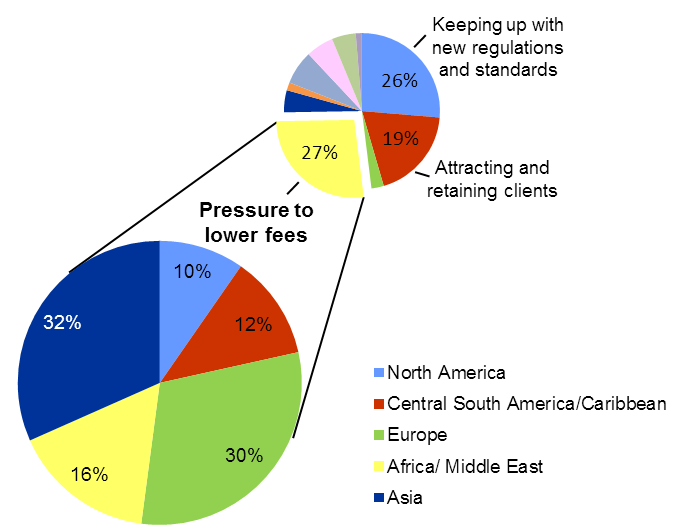
While fee pressure is nothing new%26mdash;the profession has always faced various degrees of fee pressure, in certain areas more than others%26mdash;the ongoing economic malaise has likely contributed to increased concerns about fee pressure among many SMPs. Many clients are faced with subdued demand for their products and services (tied for 3rd biggest challenge faced by SME clients in poll). They are continuing to look for ways to reduce costs, so it%26rsquo;s not surprising to find SMPs facing demands to negotiate fees or cut prices while also maintaining the quality of services that SMPs are known for.
For various reasons, this heightened fee pressure threatens to become the new norm%26mdash;lasting long after the global economy has recovered. First, clients may be determined to keep their bills down and may feel that all professional services, including legal and accounting, may not warrant the fees paid before the economic downturn. Second, globalization and the benefits of lowered costs from outsourcing to cheaper offshore contractors may prompt clients to demand a share in the cost savings. Third, technological advances mean software can perform some tasks long the preserve of trained human judgment, again leading some clients to expect to share in corresponding cost reductions. Regardless of whether downward pressure on fees is a temporary phenomenon or more permanent, the following tips should help SMPs to react to this pressure while preserving the quality of professional services rendered. Indeed, maintaining the quality of services provided in the face of ongoing fee pressure is essential not only to the reputation of individual SMPs, but in the long run, to the reputation of the entire accountancy profession.
%26nbsp;
Some Tips for Coping with Fee Pressure
-
Adopt New Approaches to Pricing%26mdash;For some service offerings, like business advisory, the hourly billing model may place a strain on the practice and value pricing%26mdash;which sets prices primarily, but not exclusively, on the value, perceived or estimated, to the customer rather than on the cost of the service or historical prices%26mdash;may be part of the solution to alleviating fee pressure. Special prices could be offered as an incentive for clients to order a wider range of advisory services. Persistent and widespread under-pricing, however, will impair the perceived value of the service over time, so such practices should be avoided. Packaging services, sometimes more desirable services together with essential but less desirable ones, can also be a useful way of getting clients to focus on the concept of comprehensive service provision rather than on hourly charge-out rates.
-
Stress to Clients the Value of Services Offered%26mdash;SMPs shouldregularly and often communicate the value of their services to their clients so that they appreciate the benefits of the services they receive. Articulating this value to clients may help mitigate fee pressure. The ability to communicate value is an important part of value pricing.
-
Focus Efforts on Most Valuable Clients%26mdash;SMPs should evaluate which clients are the most valuable by ranking them and then focusing their efforts on serving these clients. For non-audit services like business advisory, tax, and accounting, practices might wish to implement different service levels (basic, premium, etc.) to suit different categories of clients and price accordingly. This technique, referred to as yield management, is widely used in the airline industry to price seats. Ensuring a proper amount of capacity is allocated to various client segments, while offering a differentiating value proposition within each segment, is an essential element of implementing value pricing strategies. In some cases, it may pay to move away from less profitableclients.
-
Leverage Technology to Improve Processes and Lower Costs%26mdash;SMPs can implement process improvements to maintain profitability in the face of stagnant or declining fees by maximizing the use of technology. For example, cloud computing solutions offer the possibility of delivering the same services like payroll and bookkeeping for less cost. And, simple choices like using email instead of regular postal services, and SkypeTM instead of telephone or in-person meetings can also help lower costs. Practices may be in a position to pass on a portion of the cost savings associated with IT efficiencies, which will likely be well received by clients.
-
Re-examine the Practice%26rsquo;s Service Offerings%26mdash;SMPs shouldconsider whether they can add value (and hence fees) with additional services for little extra cost or provide the same for less cost. Specializing in niche markets or services might be worth pursuing to set the practice apart in the marketplace. For others, providing a broad range of advisory services and offering value pricing (see above) may prove profitable.
-
Find Cheaper Sources of Supply%26mdash;many suppliers, for anything from Internet service to computer hardware, may offer benefits to new clients that warrant switching providers. Competitive pricing and choice in suppliers may have improved considerably since the practice chose its suppliers, and therefore, warrant a fresh review.
-
Tackle Overheads%26mdash;SMPs should seek to minimize waste and make the most efficient use of resources, both human and environmental, including workspace, energy, and consumables. For example, practices should consider optimizing the utilization of expensive office space and energy by encouraging staff to perform much of their work at the client%26rsquo;s premises or at home and to pre-book a desk space when in the office. Similarly, practices should seek the most efficient use of staff through improved distribution of workloads, ensuring adequate planning and supervision of engagements, and delegating work to the appropriate levels. Flexible working hours may enable the practice to avoid staff redundancies, which can erode morale and may make it difficult to recruit new staff as and when conditions improve. Shifting more routine work onto more junior staff can help cut costs, but, without adequate guidance, could also diminish the quality of the end result, which in turn, may impair the practice%26rsquo;s brand. Therefore, staff assignments need to be managed carefully.
%26nbsp;
IFAC Resources: www.ifac.org/SMP
-
Guide to Practice Management for Small- and Medium-Sized Practices
Second Edition (especially Module 3; the 3rd Edition [December 2012] will include enhanced content on pricing) -
Links to free practice management resources and tools (especially Module 3)
-
Business Advisory Video Series, featuring tips from SMP Committee members
Article written by Giancarlo Attolini, Chair, IFAC SMP Committee (see bio) and Paul Thompson, Deputy Director, SME and SMP Affairs, IFAC
Copyright %26copy; August 2012 by the International Federation of Accountants (IFAC). All rights reserved. Used with permission of IFAC. Contact permissions@ifac.org for permission to reproduce, store, or transmit this document.
%26nbsp;
%26nbsp;
Exhibit A
|
What is the biggest challenge your practice is facing?
|
North America
(%) |
Central South America/
Caribbean (%) |
Europe
(%) |
Africa/
Middle East (%) |
Asia
(%) |
|
Keeping up with new regulations %26amp; standards
|
44
|
25
|
25
|
23
|
23
|
|
Attracting and retaining clients
|
9
|
19
|
20
|
33
|
17
|
|
Ability to adapt to changing client needs
|
1
|
4
|
3
|
2
|
2
|
|
Pressure to lower fees
|
10
|
12
|
31
|
17
|
32
|
|
Rising costs
|
5
|
5
|
4
|
5
|
5
|
|
Succession planning
|
6
|
4
|
1
|
3
|
1
|
|
Work-life balance
|
14
|
12
|
8
|
5
|
4
|
|
Attracting and retaining staff
|
8
|
11
|
3
|
6
|
7
|
|
Competition
|
2
|
5
|
4
|
5
|
7
|
|
Keeping up with new technology
|
1
|
3
|
1
|
1
|
1
|
Boldface indicates highest percentage per region.
%26nbsp;